Scaling CoolVeg's Clay Pot Cooler Training Program
Reducing Food Loss and Improving Nutrition in Arid Regions
.jpg)
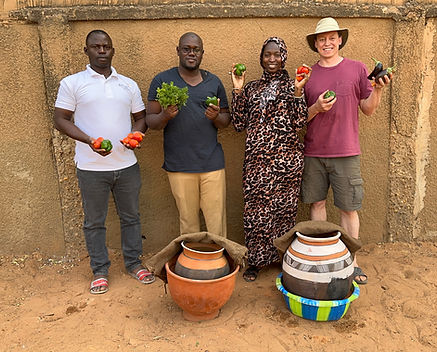
Over 8,000 people have directly participated in clay pot cooler training sessions in Mali and Niger, enabling approximately 200,000 people to benefit from the use of clay pot coolers.
CoolVeg's community-centered cascade training program is a cost-effective, sustainable, and highly scalable approach for providing communities access to a simple and affordable solution for preserving fruits and vegetables.
Key Features that Enable Effective Scaling
-
Clay pot coolers are an easy-to-assemble solution that improves fruit and vegetable shelf-life and provides households with economic and health benefits.
-
The identification of the clay pot-in-dish type of clay pot cooler that can be made from materials that are widely available in most rural settings was critical for enabling high adoption rates.
-
By including clay pot makers and sellers along with vegetable farmers, vendors, and consumers in the training sessions, the program creates both supply and demand for clay pot coolers.
-
The cascade training program leverages existing and trusted information networks as a cost-effective channel for introducing clay pot coolers into communities.
-
Informal information sharing further amplifies the dissemination of clay pot coolers.
-
When implemented at scale, this program is extremely cost-effective, costing less than $0.50 per person impacted.

CoolVeg's clay pot cooler training program was developed in collaboration with
MIT D-Lab, the World Vegetable Center (WVC), and Institut d'Economie Rurale (IER) in Mali, with support from USAID and the Islamic Development Bank.
Work With Us
CoolVeg aims to help millions of households access clay pot coolers in the next 5 years.
The Sahel region, home to roughly 180 million individuals living in off-grid, rural communities, is among the poorest, most food-insecure, and climate-vulnerable regions in the world.
CoolVeg is actively pursuing funding and strategic partnerships to expand its clay pot cooler training program throughout the West African Sahel and other arid regions where improved fruit and vegetable storage is urgently needed.